
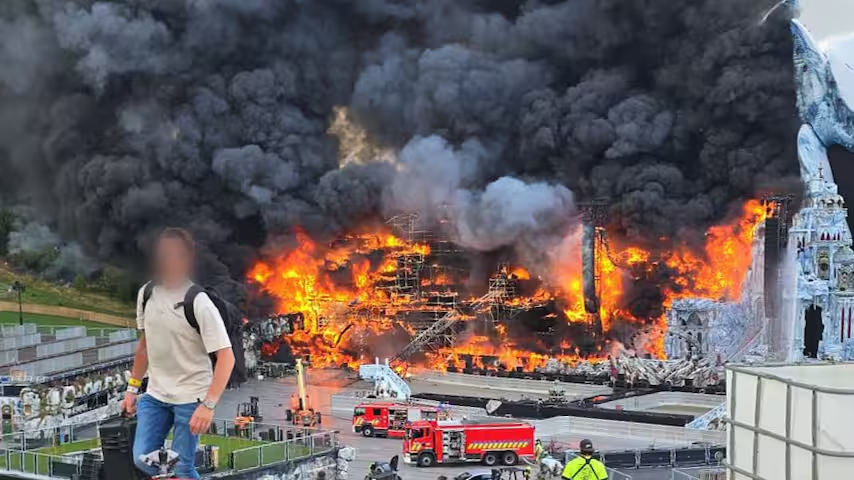
Following the dramatic mainstage fire at Tomorrowland in July 2025, Belgian municipalities Boom and Rumst are developing a new safety framework ahead of the 2026 edition.
The incident exposed a critical gap in Belgian legislation: there is currently no specific legal framework governing fire safety standards for large-scale festivals or festival mainstages.
What Happened in 2025?
On July 16, 2025, Tomorrowland’s iconic mainstage was completely destroyed by fire. While the festival ultimately continued with an improvised stage setup — symbolically marked by a golden butterfly — the incident cast a long shadow over the event.
A judicial investigation is still ongoing, and according to local authorities, few official conclusions have been publicly confirmed beyond media reports.
The Core Issue: No Legal Framework
According to Rumst’s mayor, discussions between local governments and WeAreOne.world, the organizer behind Tomorrowland, revealed a structural problem:
Belgium does not have a dedicated legal framework regulating the operation and fire safety requirements of large festivals and complex stage constructions.
For smaller events, existing regulations are usually sufficient. However, an event of Tomorrowland’s scale — attracting hundreds of thousands of attendees — operates in a much more complex risk environment.
What Will Change for 2026?
Boom and Rumst are now introducing a structured protocol inspired by a European model already used in the Netherlands.
Key elements of the new framework include:
Mandatory documentation proving compliance with specific safety standards
Detailed technical plans submitted similarly to building permit procedures
Formal advisory review by fire services, police, and emergency responders
Municipal approval of the operating license based on these evaluations
Stronger focus on fire prevention and crisis management protocols
Additionally, an external risk analysis will be conducted to evaluate vulnerabilities and recommend improvements.
Why This Matters for the Festival Industry
The Tomorrowland fire highlights a broader European issue: as festival productions grow more ambitious — with elaborate stage designs, pyrotechnics, LED structures, and temporary mega-builds — regulatory systems have not always evolved at the same pace.
This move by Boom and Rumst may set a precedent for:
Stricter safety standards across Belgium
More formalized licensing requirements
Greater accountability for organizers of large-scale events
Until the judicial investigation concludes, municipalities are aiming to create clearer safety guarantees for the 2026 edition.
Critical Perspective
It is important to note:
The exact cause of the fire has not yet been officially confirmed.
No comprehensive national reform has been announced — the initiative currently comes from the municipalities themselves.
Tomorrowland successfully continued the 2025 edition despite the incident, demonstrating strong operational resilience.
However, the absence of a specific legal framework for large festival mainstages raises legitimate questions about regulatory oversight in Belgium.
For a global flagship event like Tomorrowland, expectations around safety transparency and crisis preparedness are understandably high.